.svg)


Email marketing benchmark report 2026: Open rates, CTR & ROI across 12 industries


Email marketing remains one of the most effective digital channels for customer acquisition, retention, and revenue generation. Yet as inbox competition intensifies and privacy regulations evolve, understanding industry-specific performance benchmarks has never been more important.
Comparing your results against broad averages can lead to misleading conclusions. A successful open rate in healthcare may be considered underperforming in education, while click-through rates that exceed expectations in manufacturing could fall below average in retail.
This report examines key email marketing metrics across 12 industries, helping marketers understand where they stand and identify opportunities to improve campaign performance.
Key findings at a glance
- Average email open rates vary significantly by industry, ranging from 19% to 42%.
- Nonprofit, education, and healthcare organizations continue to achieve the highest engagement rates.
- Retail and e-commerce brands experience lower open rates but generate strong conversion volumes through high-frequency campaigns.
- Personalized, segmented campaigns consistently outperform bulk email sends across every industry.
- Organizations using multi-channel marketing strategies report stronger email ROI than those relying solely on email.
2026 Email marketing benchmarks by industry
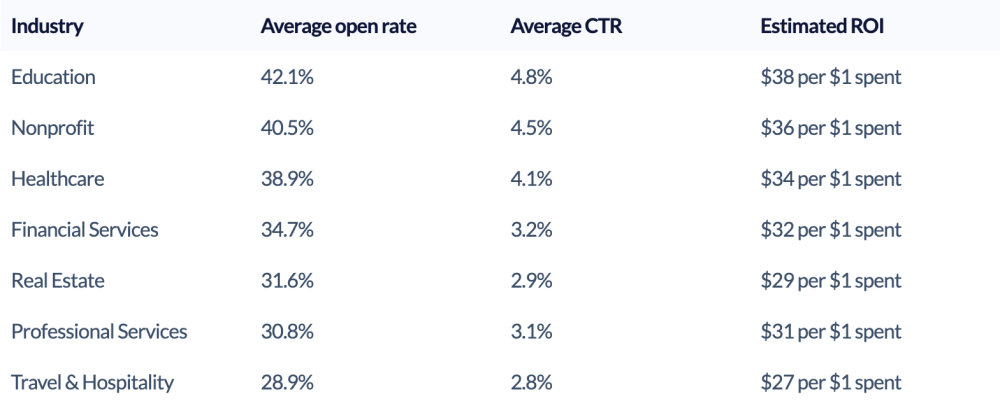
Note: Benchmark figures represent aggregated market averages and should be used as directional guidance. Actual performance varies based on audience quality, campaign objectives, list hygiene, and segmentation practices.
Why open rates alone don't tell the full story
Open rates remain a useful indicator of subject line effectiveness and sender reputation, but they no longer provide a complete picture of campaign performance.
Changes in email privacy features have affected open rate accuracy across major email providers. As a result, marketers should evaluate email performance using multiple metrics, including:
- Click-through rate (CTR)
- Click-to-open rate (CTOR)
- Conversion rate
- Revenue per email
- Unsubscribe rate
- Customer lifetime value
The most successful teams prioritize downstream business outcomes rather than focusing exclusively on opens.
What drives higher CTR across industries?
Our analysis shows that high-performing campaigns share several common characteristics:
Advanced audience segmentation
Campaigns targeted by customer behavior, demographics, interests, or purchase history generate significantly higher engagement than generic email blasts.
Personalized content
Dynamic content blocks, personalized recommendations, and tailored messaging improve relevance and increase click-through rates.
Mobile-first design
With most emails now opened on mobile devices, responsive layouts and concise messaging are essential for driving engagement.
Automated customer journeys
Triggered campaigns — including welcome series, abandoned cart emails, renewal reminders, and post-purchase follow-ups — consistently outperform one-time sends.
How multi-channel campaigns improve email ROI
Email marketing performs best when integrated into a broader marketing strategy. Brands that combine email with display advertising, direct mail, retargeting, and SMS create multiple touchpoints throughout the customer journey, increasing both brand recall and conversion rates.
For example, a prospect who receives a personalized email may later engage with a display ad or direct mail piece, reinforcing the message and improving overall campaign effectiveness. This coordinated approach helps marketers maximize the value of their audience data while creating more seamless customer experiences.
Five strategies to improve your email performance in 2026
- Prioritize first-party data collection and list quality.
- Segment audiences based on behavior and purchase intent.
- Test subject lines, send times, and calls to action continuously.
- Optimize every campaign for mobile engagement.
- Connect email efforts with broader multi-channel initiatives.
Even small improvements in targeting and personalization can generate significant gains in engagement and ROI over time.
Looking ahead
As third-party cookies disappear and privacy expectations increase, first-party data and permission-based marketing strategies will become increasingly valuable. Organizations that invest in audience intelligence, data quality, and integrated marketing solutions will be better positioned to deliver personalized experiences that drive measurable business outcomes. The future of email marketing isn't about sending more messages — it's about sending smarter ones.
Conclusion
Benchmarking is not about chasing industry averages. It's about understanding your audience, measuring performance consistently, and identifying opportunities for continuous improvement. Whether you're outperforming your peers or discovering areas for optimization, data-driven email strategies remain one of the most effective ways to build customer relationships and accelerate growth.

.svg)